ANIMAL FIBRES
This includes Silk produced by silk moths of various species - It differs from other animal fibres in that it isn't a type of hair and doesn't have scales. It's a smooth tube - hence the sheen - it's produced to create a safe cocoon in which the grub can transform into a moth.
ALPACA
There are two main Alpaca groups - the
suri is the one I am most familiar with. I don't really know a lot about the differences between the two groups (except one looks cuter than the other!).
I've spun Alpaca in several different colours - Black, Grey, Caramel, White and Brown - interestingly they have all been different in texture. I'm sure this is not down to the colour but to individual breeding. Only one has been fairly coarse - the others have been varying degrees of lovely. Not the easiest fibre to spin but not too difficult either and well worth the effort of getting it right.

My first Alpaca was from a beast by the name of Lily living in Cambridgeshire (a really pretty grey). More recently I've been spinning the fuzz of Charlie who lives in a small herd in Essex - Charlie's was the dirtiest fuzz (and the smelliest) that I've ever encountered! However, once washed, it magically transformed into a pristine white that spins into a soft fluffy yarn - so nice - but I don't know what I want to do with it yet! when I find a project for it I will share it with you.
ANGORA
This is the fuzz from the Angora Rabbit - a pretty cloud of fluff with a face poking out at one end! (Angora goats provide us with Mohair).
Angora is wonderful - quite difficult to spin - but I manage by carefully carding on my fine cotton carders and then spinning with a slow draw (so it doesn't pull into the machine too quickly) and I put a fair amount of twist in. Once spun and washed it fluffs up with a halo - in fact if you want to knit or crochet it can be helpful not to wash until after working up, so that the halo doesn't get in the way of working - all a matter of preference.
Like Alpaca there are many different colours of Angora Rabbit - but you are most likely to be able to buy white only as this is most freely available. Quite often you will find Angora in a mix e.g. Alpaca, Silk and Angora.This is helpful as all the hard work in preparation is done for you and if you want to you can spin straight from the "top".
CAMEL
I'm sure anyone reading this doesn't need to be told what a camel looks like! Scruffy, lumpy, moody beasts. Their down is marvellous though and is the stuff of camel hair coats. In fact camel down comes in a variety of colours from almost white, through caramel to brown, but is most frequently only sold in typical camel colour - a sort of warm caramel. It's one of many fibres that has to have the guard hairs removed before spinning, though, like the others, the guard hairs can be spun in their own right to a coarse hairy thread or string.
I've spun camel - it was the first fibre that I practised long draw style spinning with and it was really lovely. I feel that it's really not suitable for a worsted style of spinning as the fibres are very short and downy. The results were very pleasing and I look forward to spinning camel fibre again in the future.
CASHMERE
The most expensive of fibres this one - I handled a small sample once but I've never spun it. It's harvested from Cashmere goats and I believe the expense has a lot to do with the time consuming removal of guard hairs.
Cashmere is very fine and soft and I hope one day to be able to afford to work with it to create a special project.
CAT
The fur from long coated cats e.g. Persians can be spun very effectively. Long coated cats need regular grooming and the fuzz that's collected in the comb or brush can be saved for spinning. It is very similar in texture to angora fur and spins up into a yarn with a similar halo. It's nicer to spin than dog fur as it doesn't smell at all.
DOG
Many species of dog have fur that can be spun. Probably the best is Samoyed, but I've seen wonderful results from German Shepherd which was also lovely warm colours (see pic below) - this was spun by one of our guild members who tells me that she's just finished spinning some Spanish Water Dog fur. I've only spun Poodle fur myself - it spun up quite easily and made a nice, if very slightly hairy yarn. It's biggest drawback for me is that it began to smell quite doggy when my hands got warm. I would still very much like to try a few other species to see what they are like.
.jpg)
The following picture is a little treasure bag made from poodle fur - spun into a singles yarn then crocheted & fulled.

LLAMA
These animals are closely related to Alpacas - the difference being that llamas are more frequently mainly pack animals and consequently their fleece contains more guard hairs which need to be removed for spinning. Like Alpacas they are members of the camelid family.
The fleece is not dissimilar to alpaca if a little coarser in the main. I have recently spun a mix containing llama, silk and wool - it was a little hairy but spun quite nicely - I'd dyed it prior to spinning with a mix of colours - using acid dyes and food colouring in my slow cooker. I then spun a dyed singles and an undyed singles which I plied together.
MOHAIR
This is another goat fibre - it not the hair of a Mo it is, in fact, the fuzz from the Angora Goat. It's quite different from cashmere in that it's not so fine - instead mohair is quite lustrous and is particularly known for the halo it gives a finished fabric.
I don't particularly like mohair garments and consequently haven't got around to trying it for spinning.
QUIVIUT
This is the fibre obtained from the musk ox and spinners who've worked with it rave about it - so I look forward one day to finding a source and buying some to play with. It is brown in colour and quite downy - once again it is one of those fibres that has guard hairs which need to be removed before spinning. The finished items made with quiviut are supposed to be very warm to wear.
WOOL
There are so many species of sheep that I plan to do a separate post with an overview of as many different varieties as I can find out about - so look out for that soon.
YAK
Yaks are members of the bovine family and are said to be quite bad tempered - I've never met one so I can't vouch for this! The wild ones are black in appearance with a long black outer coat of coarse guard hair and a rich brown downy undercoat. This undercoat is wonderful to spin - it behaves a lot like camel and other downy fibres. Once spun and washed it fluffs up nicely in a woolly way as opposed to, for instance, angora which is very fluffy.


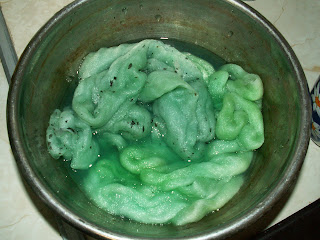

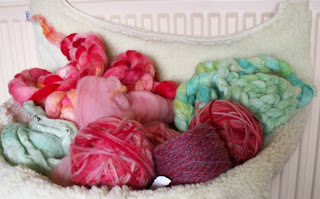


 Finally it was all spun - I wanted to wash it and measure it, so I put it into skeins with my swift - (it was almost 100m worth). Then I washed it and left it to dry.


